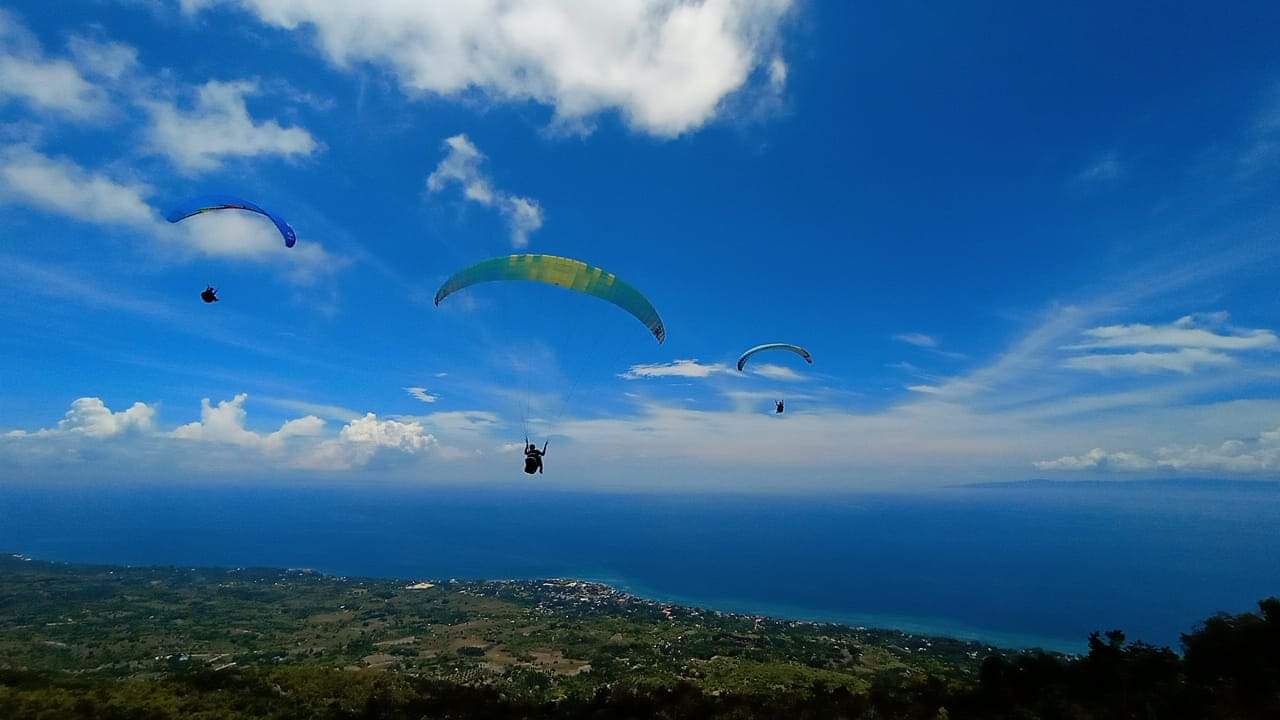
BECOME A PILOT
From ground handling to solo flight — your journey starts in Oslob
As Featured By


Training Program
Learn to Paraglide in Oslob, Cebu
Our training program takes you from complete beginner to confident solo pilot — step by step, at your own pace. Oslob's consistent winds and 1,739 ft elevation make it one of the finest training sites in the Philippines.
Ground Handling
Stage 1 — Foundation
"The most physically demanding task, yet the most important part of learning to fly."
- Wing inflation and kiting on the ground
- Forward and reverse launch technique
- Understanding the wind window
- Equipment setup, inspection, and packing
- Basic aerodynamics and meteorology
3–4 consecutive days
Launch & Landing
Stage 2 — First Flights
"Once you can control the glider on the ground, we teach you how to take off and land safely."
- Supervised take-off and landing
- Tandem flights with instructor for confidence
- Glide path and approach control
- Emergency abort procedures
- Radio communication with ground instructor
3–4 consecutive days
Essential Maneuvers
Stage 3 — Solo Flight
"You'll learn the essential in-flight maneuvers and air traffic rules before flying on your own."
- Turns, figure-8s, and 360° circles
- Big-ears and speed bar use
- Incident and emergency management
- Air traffic rules and flying etiquette
- Weather reading for flight decisions
After completing Stages 1 & 2
All Stages Include
Everything You Need
Equipment
Wing, harness, helmet, and reserve parachute provided throughout your training
Training Manual
Training manual and flight record logbook to track your progression
Pilot ID Card
Official pilot ID upon completion, including insurance info and pilot rating
Certified Instructor
Personal coaching from experienced OCPD pilots throughout all stages
Before You Enroll
Requirements
No prior experience needed
We start from zero. Having done a tandem flight beforehand helps, but is not required.
Reasonable physical fitness
Ground handling involves walking on slopes carrying the wing — you don't need to be an athlete, but basic stamina helps.
Proper footwear required
Outdoor sports shoes with ankle support are mandatory. Sandals and slippers are not allowed.
Medical clearance recommended
Highly recommended before starting, especially if you have existing health conditions. Instructors can accommodate limitations where possible.
Not suitable if pregnant
Or if you have serious heart, neurological, or back conditions that prevent physical exertion.
Ready to Start?
Training schedules depend on weather and instructor availability. Message us on Facebook to check the next available slot and get your course quote.
Pilot Rating
Upon completing the full program you receive your official Trainee Pilot rating and a pilot ID card. Advancement to Novice Pilot status requires a minimum of 40 logged flights after certification.
Common Questions
Learn to Fly FAQ
Do I need to do a tandem flight first?
It's not required, but strongly recommended. A tandem flight helps you get familiar with the sensation of flying and confirms paragliding is something you want to pursue before committing to a full training program.
How long does the full program take?
Each stage takes 3–4 consecutive days under good flying conditions. The full program typically spans 2–3 weeks, accounting for weather days and rest between stages.
Is ground handling really that important?
Yes — it is the foundation of everything. A pilot who cannot control the wing on the ground will struggle in the air. Stage 1 is the most physically demanding part, but mastering it makes every subsequent stage significantly easier and safer.
Can I buy my own equipment after training?
Yes. After completing the program and getting your pilot rating, we can advise you on selecting appropriate beginner equipment — wing size, harness type, and reputable brands suited to your flying goals and budget.
What happens if the weather is bad during my training days?
Weather make-up days are included. If flying conditions are unsafe on a scheduled training day, we reschedule at no additional cost. This is why we recommend staying flexible with your schedule, especially during the wet season.
Take the Next Step
Start Your Journey as a Pilot
Oslob's consistent ridge winds and 1,739 ft elevation make it one of the best natural training environments in the Philippines.